

Peter's Model Railroading | The Layout | Hazel Mine, Canonsburg, PA - Module #2
Track #2


It is hard to believe that it was almost 4 years ago that I put the first five tracks down on the first module. My, how time flies! Micro Engineering took over production and sales of S-scale's flextrack product in 2025, and I bought the code 100 version when it was available for ordering. It arrived just as I was wrapping up the construction phase of this module, so it was perfect timing. The big issue, and I spent a few days thinking about this, is what the shape of the track should be. Prototype photos show a definite curve in the outfeed yard of the tipple, back toward the main Chartiers branch line. However, period track drawings (e.g. Sanborn maps) show a substantial amount of straight track before the five tracks curve and then merge. I decided to go by what the early 1900s photos show. When laying multiple side-by-side tracks on a curve, you always start with the inner curve, otherwise, if you start with the outside track, the inner curve winds up being too tight. I used metal weights to hold the track down once I had the curvature I wanted, as well as two small clamps to keep the rail in perfect alignment with the rail from the first module. The light-blue paint for the ceiling tile was actually a blessing, because it allowed me to trace out the area where I needed to apply the glue for the track. I used Liquid Nails glue for the first module, but I didn't have any on hand, so I just used yellow carpenter's glue for these flextracks. Worked just fine.
(external link: Micro Engineering)

The track positions under the tipple was based on photos and the actual scale-drawing dimensions of the structure. This wound up spacing the tracks about 14 feet apart from each other. Real-world track spacing standards are 13 feet for straight parallel tracks. I decided to do the same spacing for this slightly-curved track as well, so in addition to placing a curve in the second module's tracks, I also got them to have a 13-foot spacing by the time they reached the left edge of the second module. This is what my wooden track-spacing jig is for.

I don't have much time for the hobby, so I just glued one section of flextrack each night, so after a week, all five of them were down. If you compare the left edge of the ceiling-tile area with that of the above photo, you'll see that I put a small strip of Gatorfoam under the tracks. This is because the ceiling tile isn't exactly 24 inches wide. So, I put in the filler strip.

Next, I painted the surface a dark green. I wasn't sure I had enough paint to cover the front and side panels, but once I did, I was able to continue to paint the top surface, too.

The next step is to cut off the extra track, so in preparation for that step, I applied Aleene's Tacky Glue to the first five ties (outside rail surface only) to help hold down the rail when I cut the rail later on. It's the same method I used in the first module, and since it worked well there, no sense in trying something else.

I used the same method as with the first module to cut down the lengths of the tracks. Further clean-up will be done in the future. I was then able to apply three different shades of paint to the sides of the rails to make them look like well-used rails.

For me, ballasting is a multi-step process. The reason is that I learned many years ago that if you just cover the track with ballast and then do the normal "wet water and diluted glue" method, the bottom of the ballast never gets saturated with glue. This, eventually, leads to fracturing and breaking off of chunks of ballast. So, I build mine up in multiple, very thin, layers. In this photo, I attached some plastic grocery bags to the end of the module, so that it can catch errand ballast and oversprays. I have applied the first layer of ballast that is about the size of 1-2 scale inches. The tools I use to glue the ballast down are shown in the photo. I mix white glue 50/50 with water. I have a quality spray bottle that holds 91% isopropyl alcohol in it, and I use a syringe to apply the glue one drop at a time. First, I spray the entire section of track with the alcohol. I then fill up the syringe with glue (which has been thoroughly mixed). Next, I again spray a small section (4-5 inches) of track with the alcohol to get it really wet, and then carefully apply one drop of glue from the syringe on to the ballast. Sometimes the glue doesn't sink into the ballast, so I do another light spray with the alcohol. I just keep going like that until I am done.

I had been applying the various layers of ballast all the way up to the first module, as if the two modules were permanently attached to each other. When it was time to add the final layer of ballast, I pulled the two modules apart (actually quite difficult to do), and this is what I was left with. Bigger chunks of unsupported ballast were removed, but I pretty much left it as it was. The reason why I needed to do this is because I want the final layer of ballast to match up with the tops of the ballast in the first module. It turns out that the white I-beams aren't perfectly straight and/or the modules' construction isn't quite a match and so there is an unevenness between them. By pulling them apart, I can fine tune the second module's position by inserting some index cards under it and under the first module, to get them to line up better.

The ballast in between the rails is now complete.

This is a view down the tracks. So, what I decided to do was to "feather out" the top layer of finer "coal dust" that falls from the cars over the years, as the track gets farther away from the tipple.
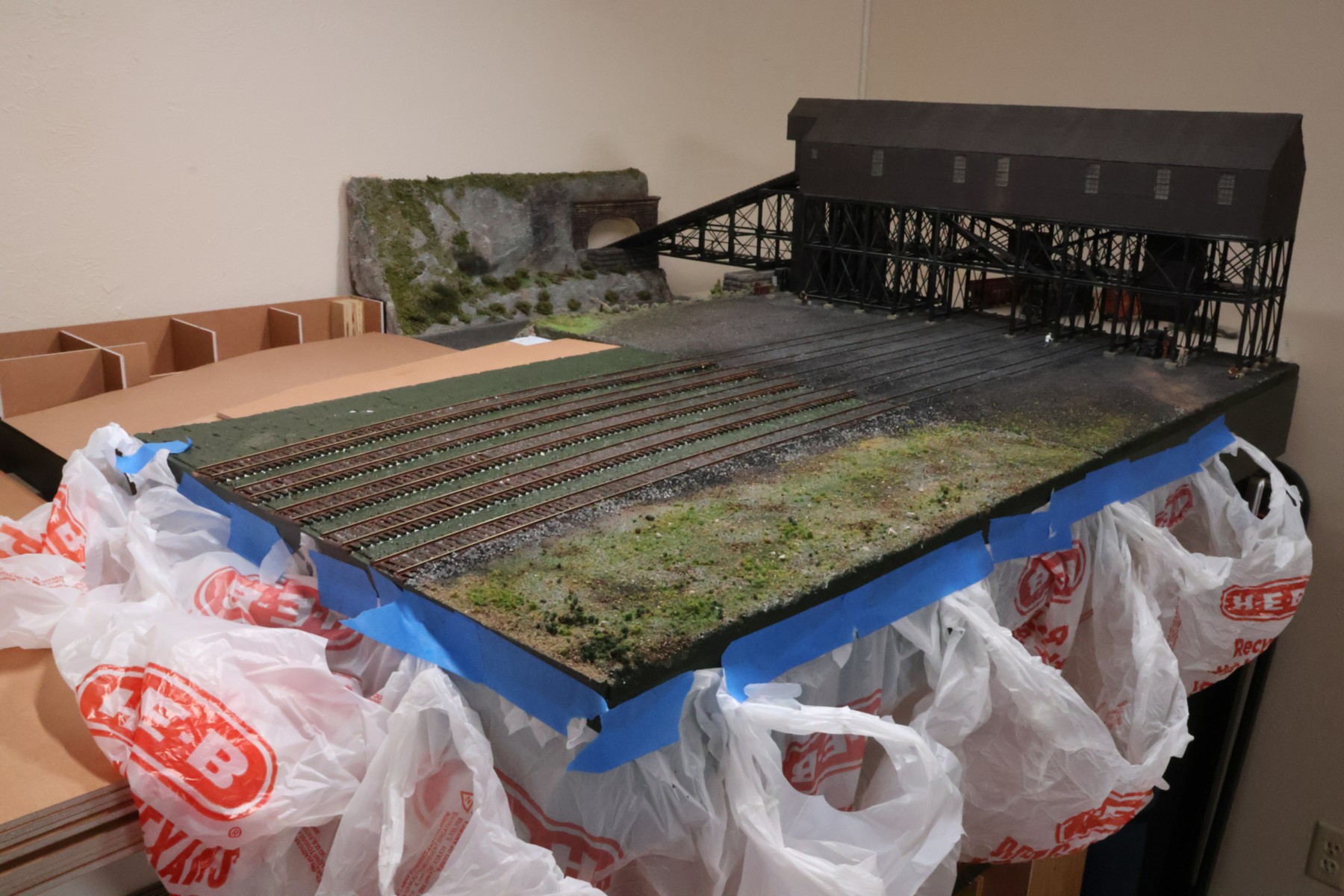
Now it is time to fill in the rest of the base of the scenery, to make it look more "lived in". I decided to start at the front. Since there was likely to be some overspray of the glue near the front edge, I taped more grocery bags to the layout. As far as the scenery base itself, I did several layers of ballast and coal, and then a few days later, added a bunch of different ground-foam type products of various sizes to the front area. When that was done, I covered the whole area with a glue-mixture in a fine-spray bottle to soak it all down. I will be adding one more layer, next.
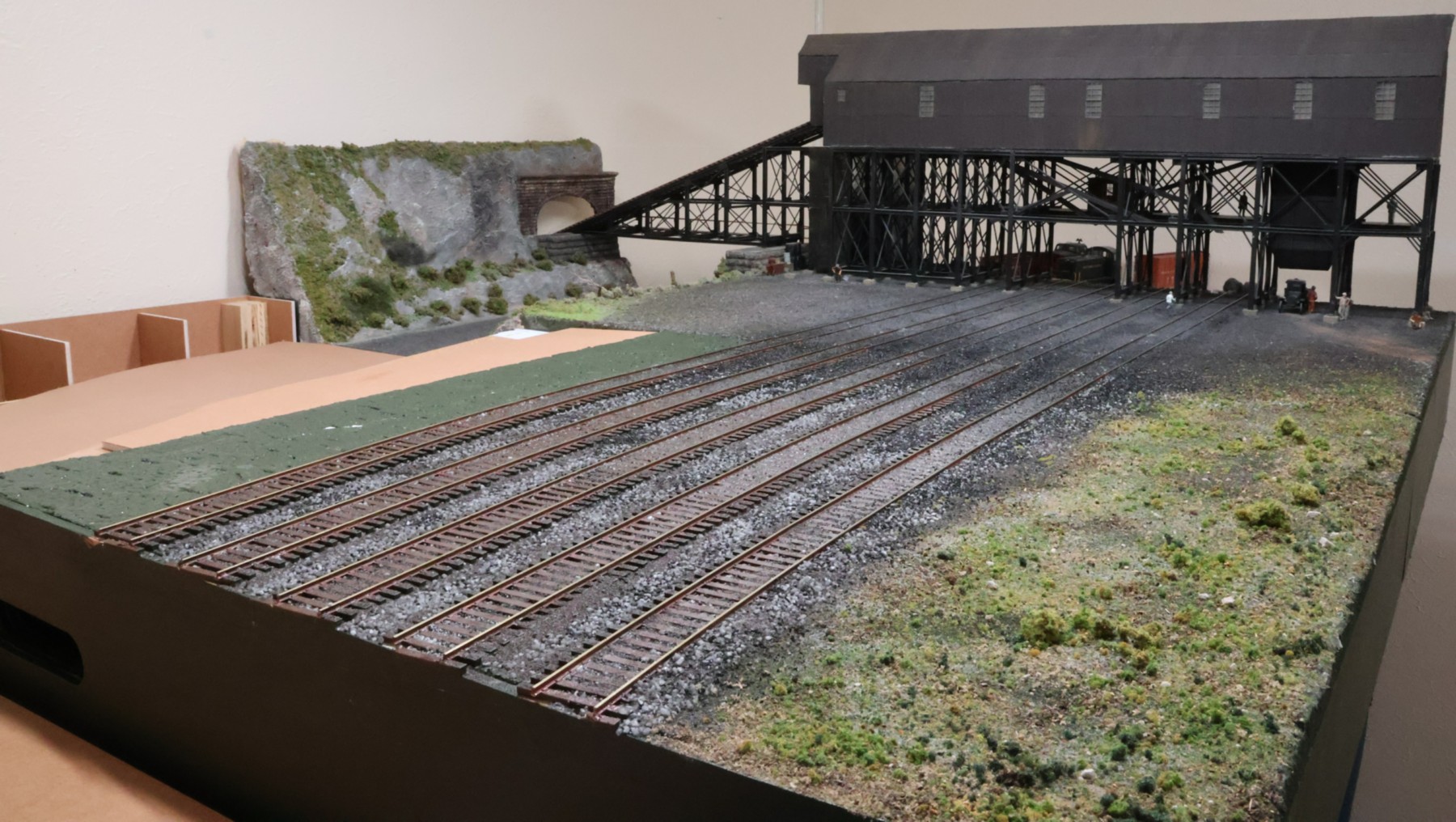
This completes the track side of this module. All of the ballast that I want is down and all of the scenery between the tracks is done as well. The back half of the module I consider "scenery" and that will come some time in the future.
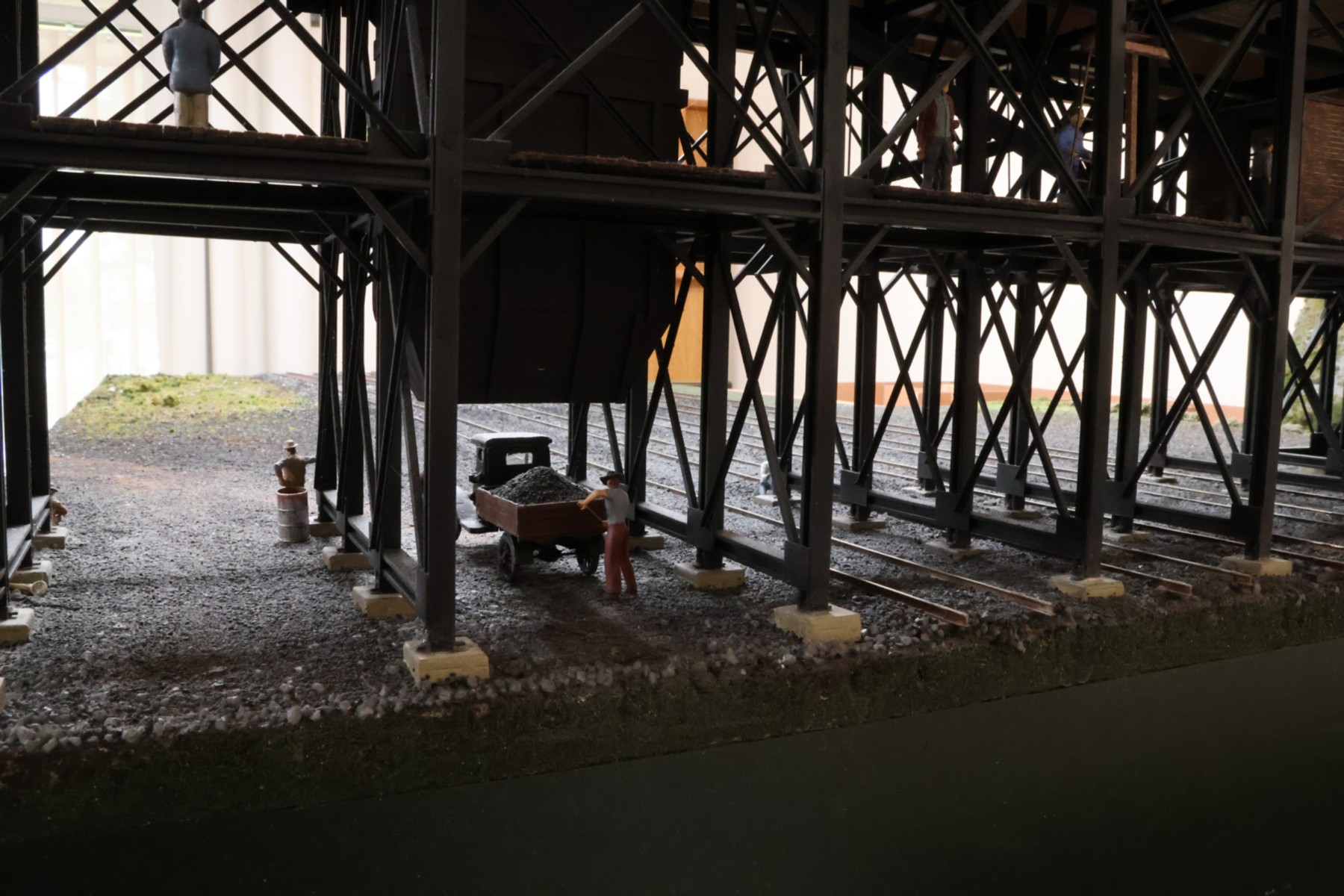
This is the view from the first module, back to the second module.