

Peter's Model Railroading | The PRR Chartiers Branch | Equipment
H10

Purpose
The PRR 2-8-0 wheel arrangement (commonly referred to as a "Consolidation") was represented by three classes, namely H8, H9, and H10. Externally, there was little differences between the three classes. The main differences were the cylinder bore sizes. This was 24" for the H8, 25" for the H9, and 26" for the H10 (these are hard to tell apart in our scale models). These locomotives were pretty much only used for pulling freight trains. The H10 class was primarily built for the PRR's Lines West, and so that will be my personal focus, as the Chartiers branch fell under that region. After the 4-6-0 G5, the H10 was probably the second most-often-seen engine on the branch line. The Lines West version has a high-side tender, to increase its coal-carrying capacity. Engine #8259 worked on the branch line until 1957.
Construction
These locomotives were built by Baldwin, Alco, Lima, and the PRR's Juniata Shops. The H8 was built from 1907 through 1913. The H9 was built in 1913 and 1914. The H10 was built concurrently from 1913 through 1916. There were a total of 480 H8 locomotives built, 274 H9 locomotives, and 273 of the H10 class. Over time many of the H8 locomotives were rebuilt and redesignated into the H9 or H10 class. Most were super-heated, so technically these should be called H8s, H9s, and H10s. They use the Walschaert valve gear.
Specifications
These locomotives had 62-inch driver wheels and 33-inch pilot wheels. The engine's length was 36'1", and the tender was 29'10" long, making for a total coupled length of 66' (this is 12-3/8" in S-scale / 1:64).
Performance
These locomotives could produce 53,200 pound-feet of tractive effort.
Photos
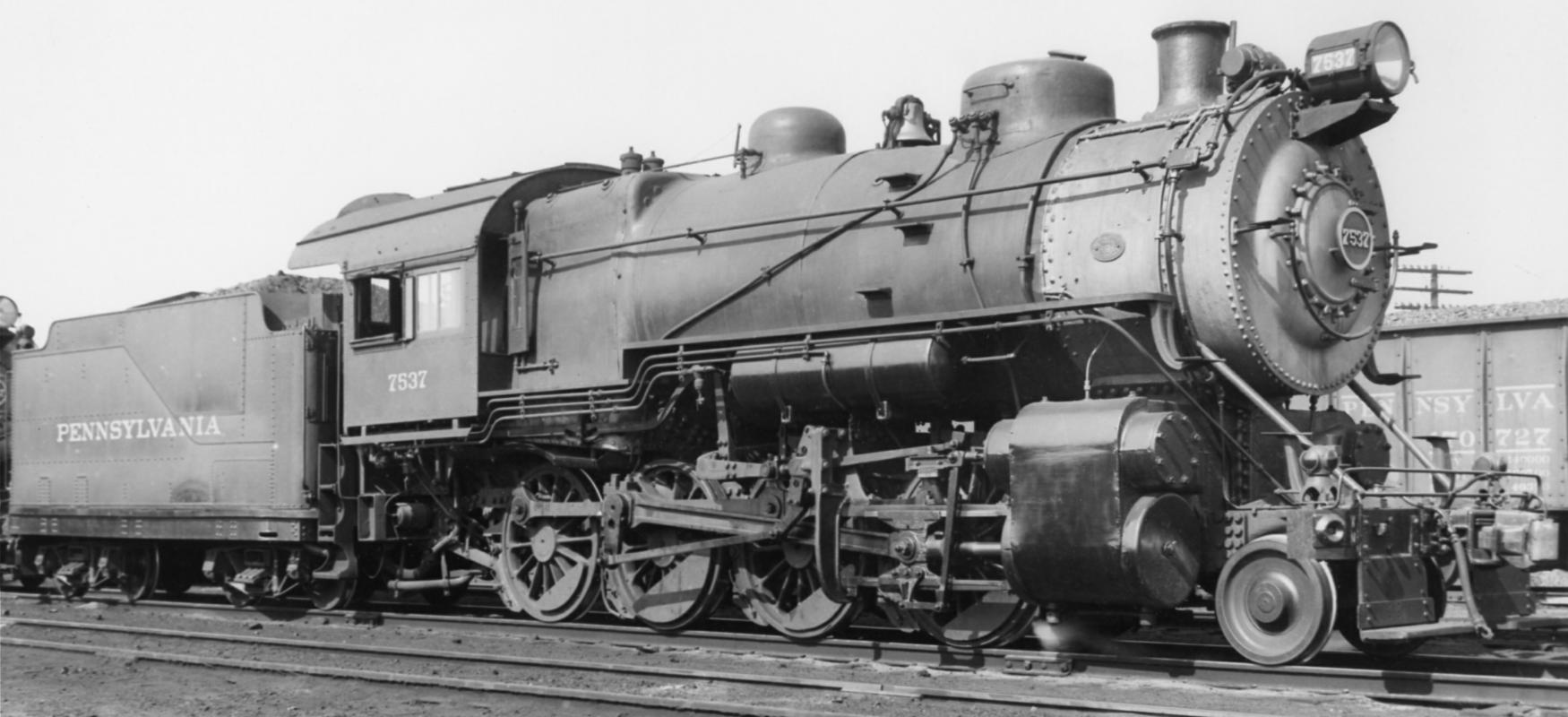
photo from author's collection
References
Data
- Steam Locomotives Cyclopedia Volume 1, page 54 and 55 contains photos of the Lines East and Lines West versions, and scaled drawings of both the engine and the tender, as well as a top-down drawing of the wheels.
- Wikipedia entry
- Guide to North American Steam Locomotives.
- PRR #7688 (H10, built by Lima) was added to the National Register of Historic Places in 1979.
Photos
- Photo of #8827
- Many photos
- Photos of #7688
- Photos of #7688 (scroll to the right; click to enlarge photos)
- Photo of #7688